← Back to research
Manuscript · 2026
A comparative investigation on molten salt hot corrosion of GTA and SMA-welded super-heater pipes of 70 MW CFBC boilers
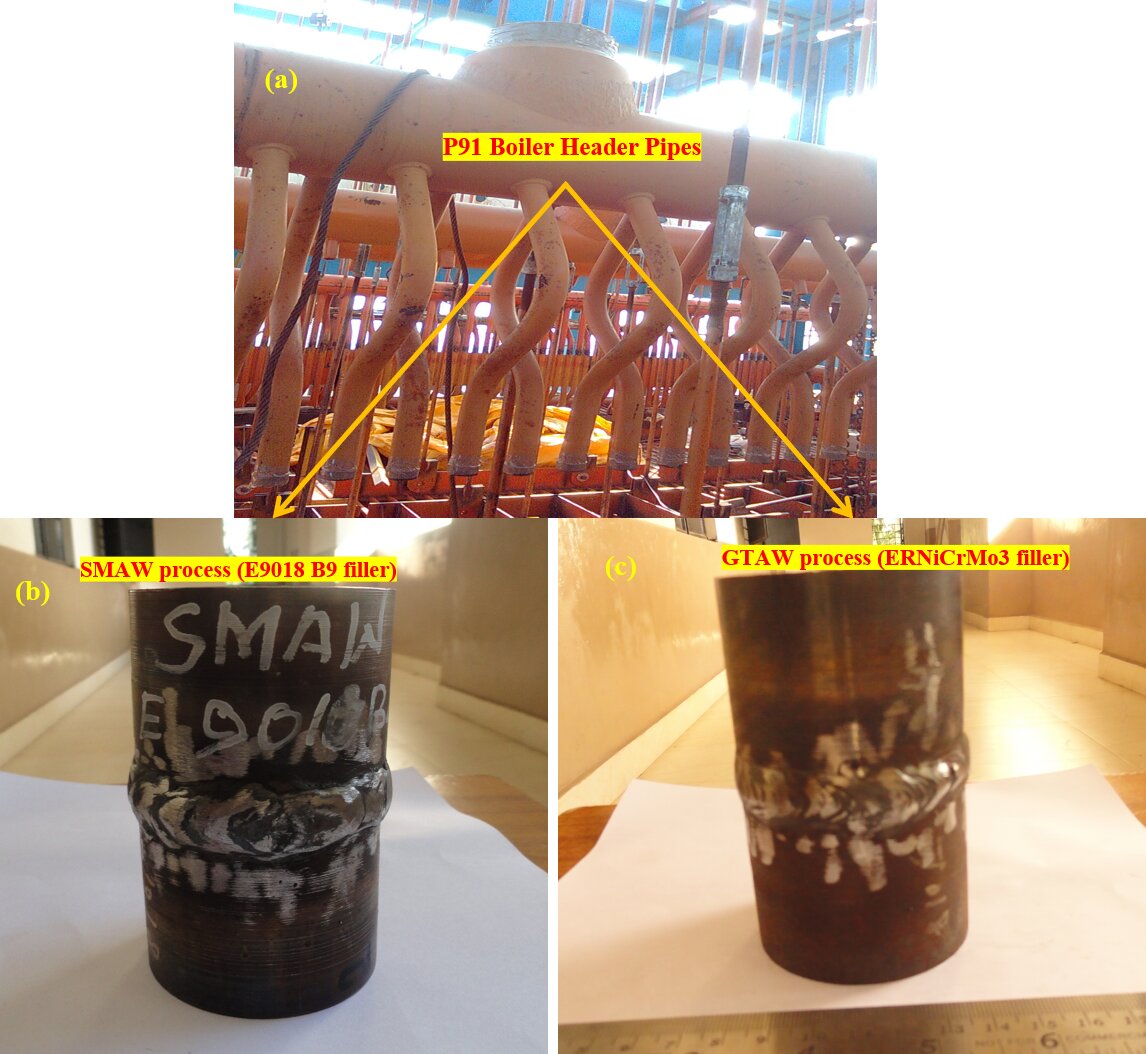
SA335 P91 superheater pipes in circulating fluidized bed combustion (CFBC) boilers get welded in the field using whatever process is practical, and the two most common are gas tungsten arc welding (GTAW) with an ERNiCrMo-3 (Inconel 625) filler, and shielded metal arc welding (SMAW) with an E9018 B9 filler that closely matches the P91 base metal's own composition. Both fillers work mechanically. The question this study asked was which one actually survives a real molten salt hot corrosion environment better, since that is what ultimately limits pipe life in service.
We took pre-used P91 boiler header pipes from a real 70 MW CFBC boiler and exposed similar-metal GTA and SMA welded joints, along with the P91 parent metal, to a Na₂SO₄+60% V₂O₅ molten salt environment at 770±1°C for 50 cycles, an aggressive Type-2 hot corrosion condition chosen because V₂O₅'s low melting point (670°C) makes it a genuinely harsh eutectic. We tracked weight change through TGA, identified oxide phases with XRD, and mapped the corrosion morphology with SEM/EDS.
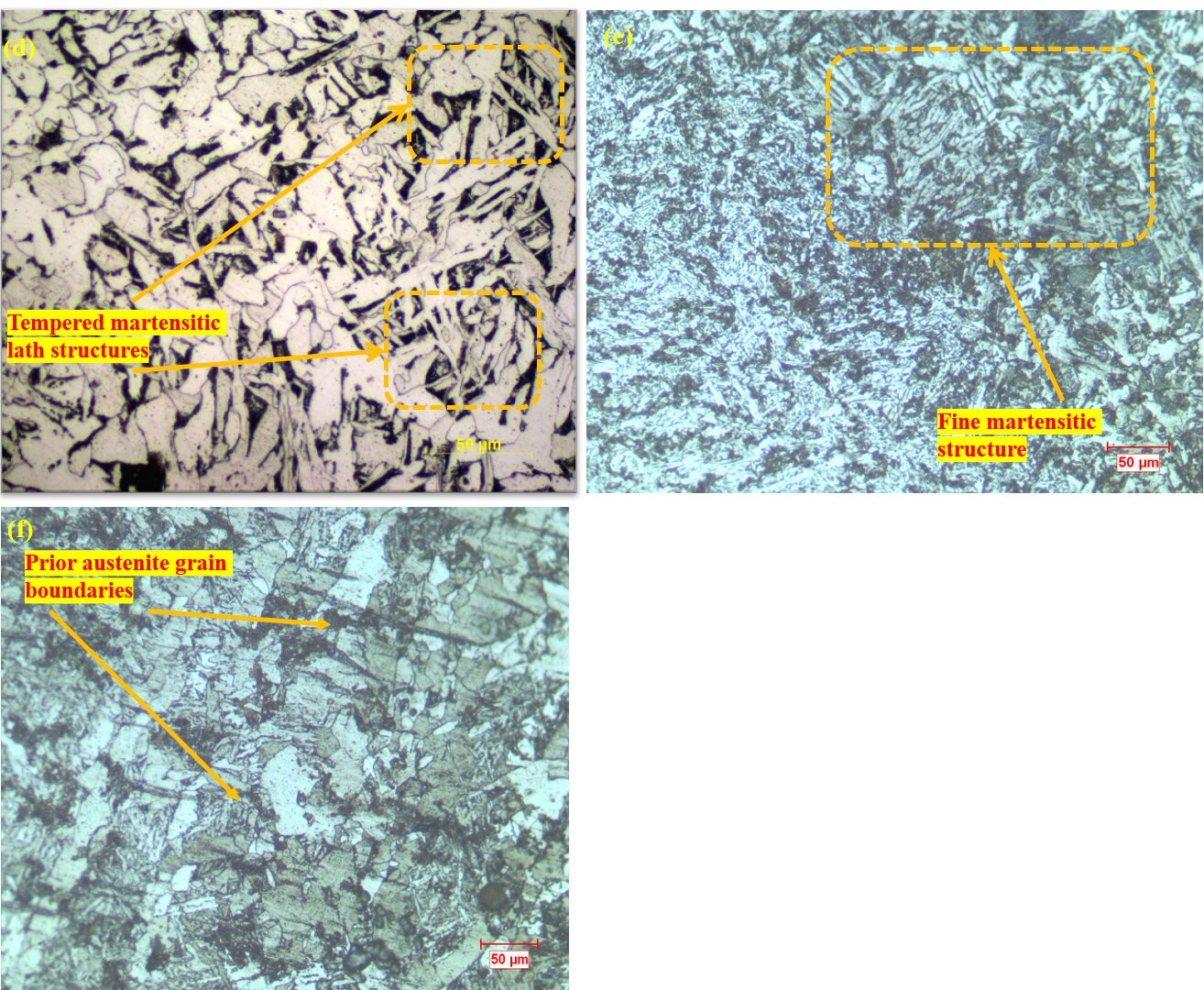
The P91 parent metal showed the expected tempered martensitic lath structure, organized into packets of parallel laths. The GTA weld, cooling rapidly under the GTAW process, produced a fine, uniform martensitic matrix. The SMAW deposit told a different story: a coarser microstructure with prior austenite grain boundaries enclosing the martensitic lath substructure, a direct result of SMAW's inherently higher heat input, which promotes more austenite grain growth during solidification.
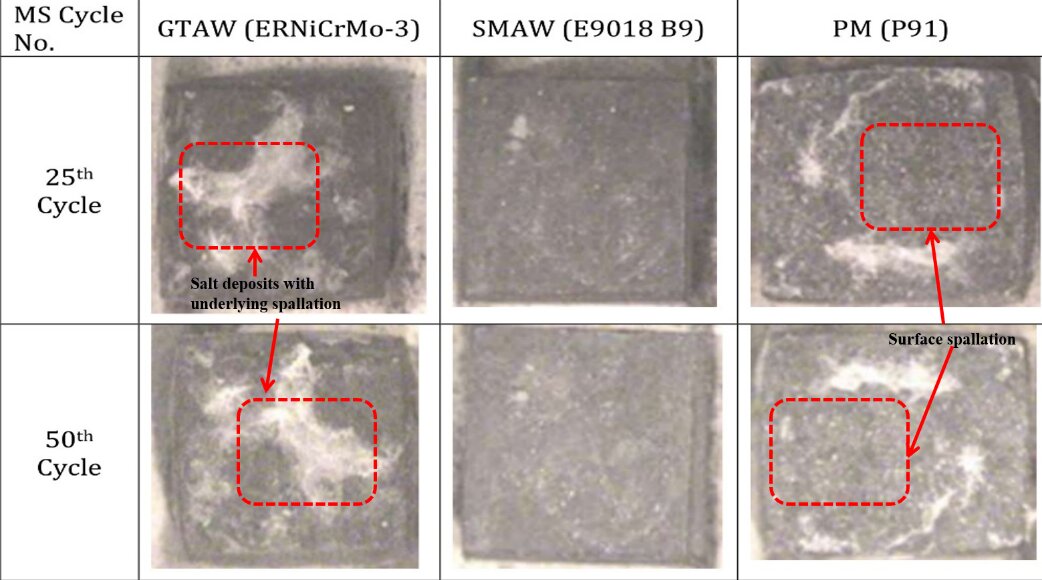
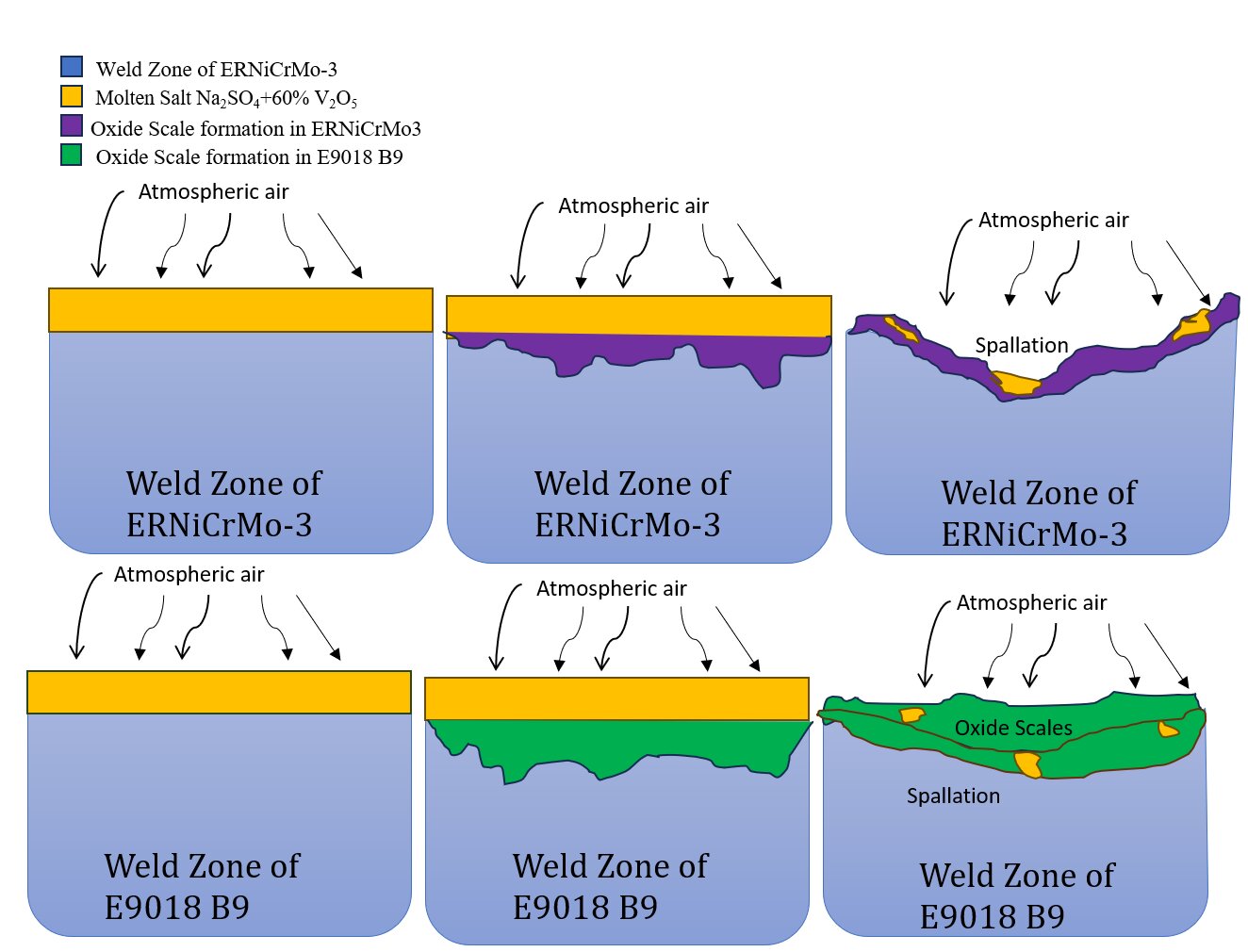
All coupons turned grey after the first cycle, then brown from the fifth cycle onward, then pale black with small white patches by cycle 50, with no full spallation on any coupon. The white patches showed up more on the ERNiCrMo-3 weldment than on the E9018 B9 weldment. Isolated corrosion scale lifting appeared on the E9018 B9 weldment starting partway through the cycles, without the white patches seen on the Ni-rich filler. Blistering appeared on every coupon, but no coupon lost its oxide layer entirely through spallation across the full 50-cycle run.
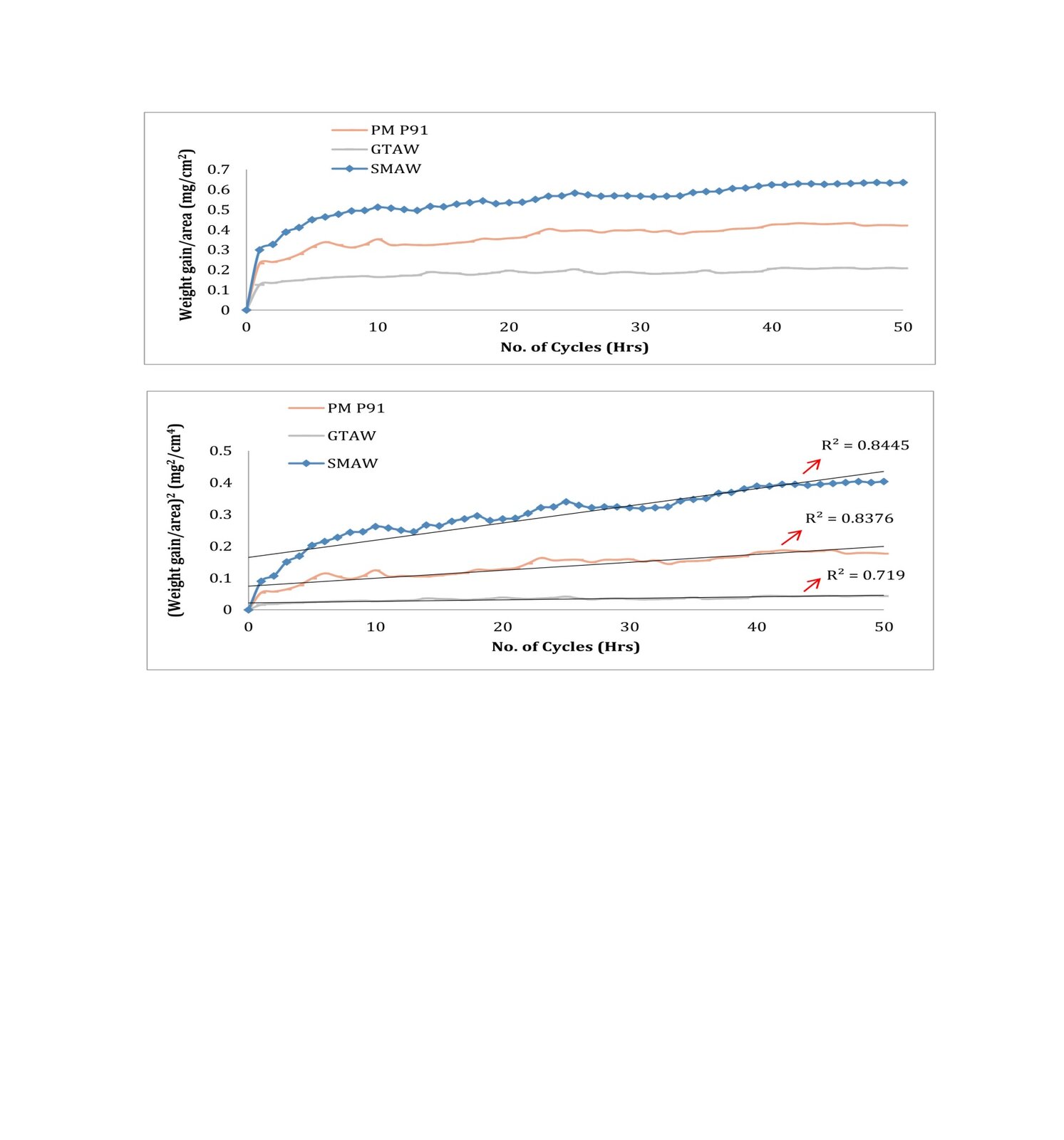
Weight gain was highest in the early cycles and grew progressively through the rest of the run for all three coupon types, but SMAW (E9018 B9) gained the most weight overall, more than both the GTAW filler and the P91 parent metal. The calculated parabolic rate constants confirmed this cleanly: GTAW (ERNiCrMo-3) came in at just 1.197 ×10⁻⁸ g²cm⁻⁴s⁻¹, far below SMAW's 11.215 ×10⁻⁸ and the P91 parent metal's 4.912 ×10⁻⁸. The R² values (0.72–0.74) show the oxidation only approximately follows ideal parabolic kinetics, which is expected under thermally cycled molten salt corrosion, where repeated scale cracking and localized spallation keep disturbing the diffusion path.
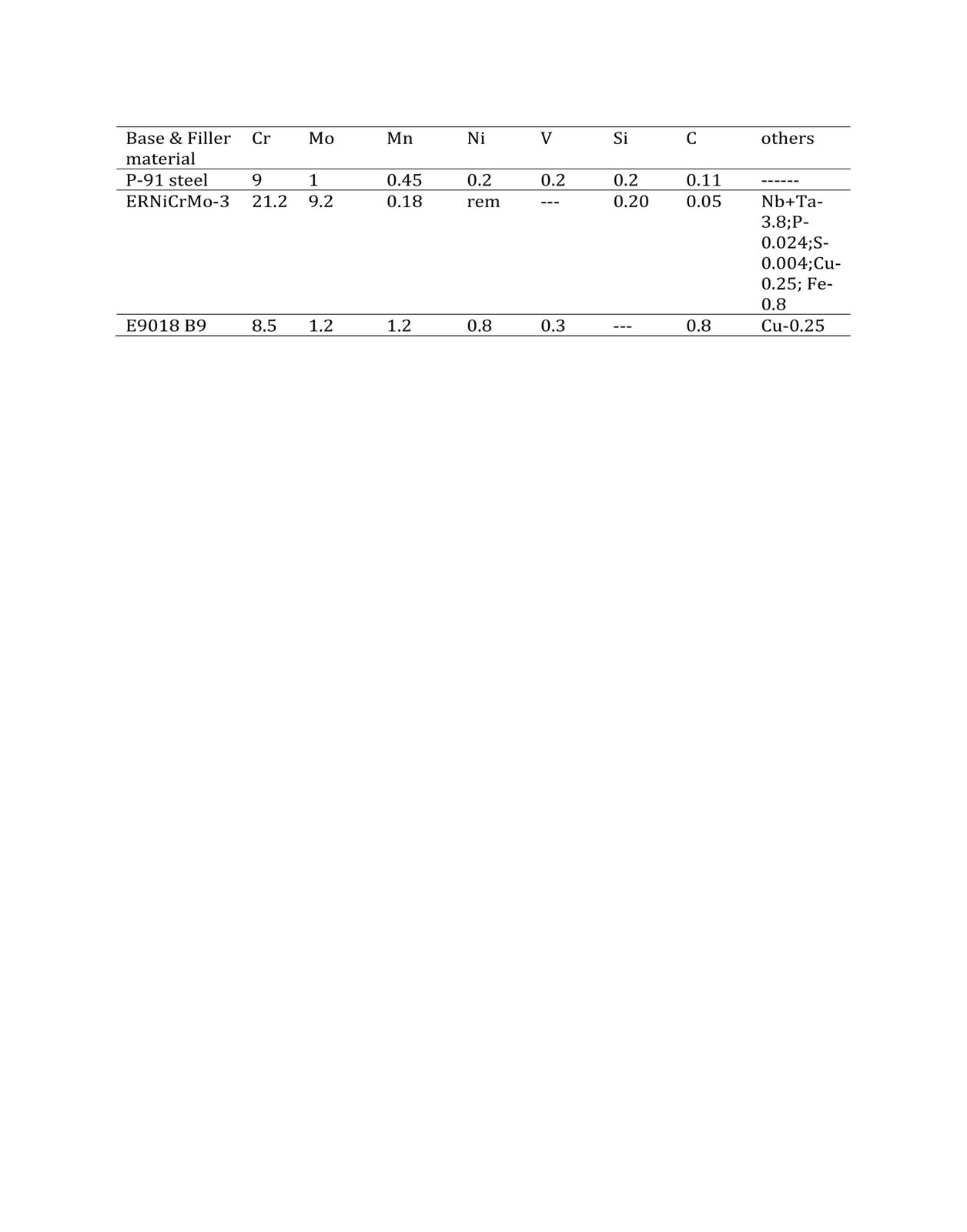
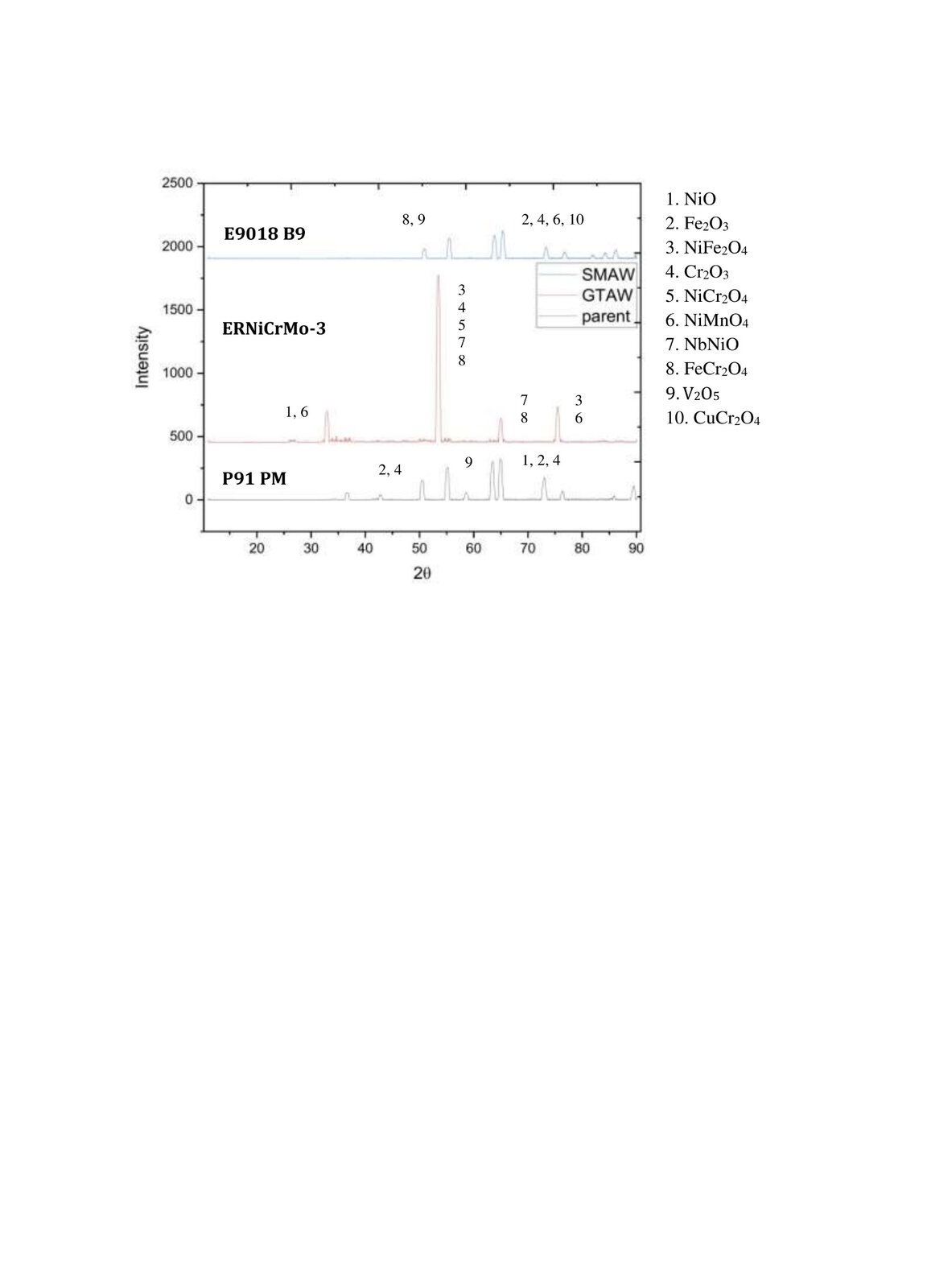
XRD told the mechanistic story behind the TGA numbers. The P91 parent metal formed mostly Fe₂O₃ and Cr₂O₃. The GTA weldment (ERNiCrMo-3) formed a genuinely protective set of phases: NiFe₂O₄, Cr₂O₃, NiCr₂O₄, and FeCr₂O₄ as major phases, with NiO and other minor spinels rounding it out. The SMA weldment (E9018 B9) went the other direction entirely, forming NiMnO₄, CuCr₂O₄, and Fe₂O₃ as major phases, with only minor Cr₂O₃.
That difference matters because Cu and V oxides form low-melting eutectics that actively transport corrosive species and accelerate spallation. On the SMA side, V₂O₅ is the more damaging offender: it degrades protective scales more aggressively than the Cu- and Fe-based oxides it forms alongside. On the GTA side, the NiFe₂O₄ spinel layer is the real hero: its dense crystal structure and low defect concentration sharply reduce ionic transport through the scale, and it adheres far better than an Fe-rich oxide because its thermal expansion is closer to the substrate's, making it less prone to cracking under repeated thermal cycling.
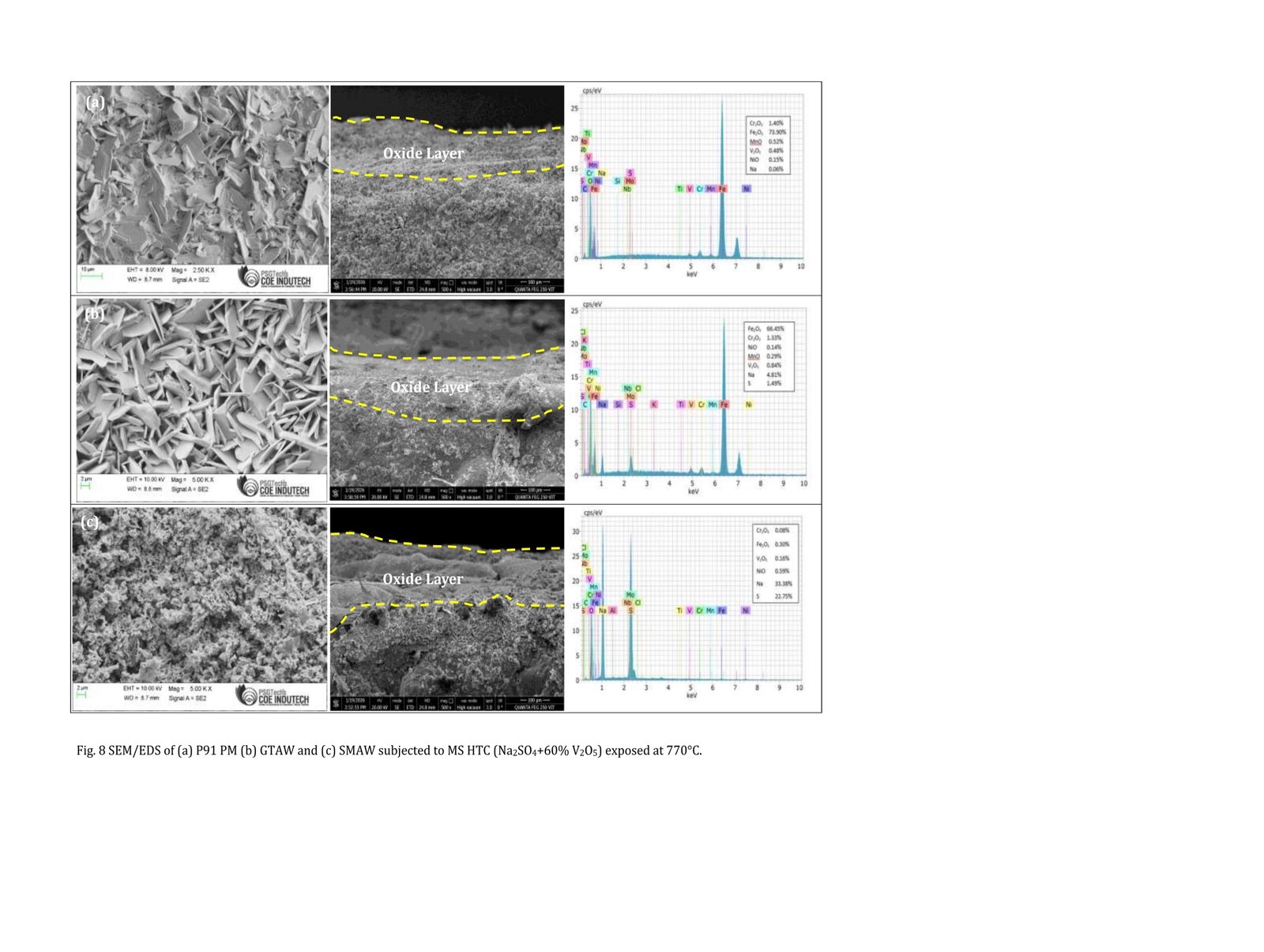
The P91 parent metal's surface showed a splat-shaped morphology with EDS confirming Cr₂O₃, NiO, Fe₂O₃, MnO, and V₂O₅ alongside modest Na residues, and the low-melting V₂O₅ eutectic tends to peel these protective Cr₂O₃/NiO scales off during the run. The GTA fusion zone showed a smaller, flake-shaped morphology, with Na and V residues confirming an aggressively low-melting environment, but a higher weight percentage of Cr₂O₃, NiO, Fe₂O₃, and MnO, which is exactly what a Ni-Cr-Mo-enriched filler should produce at elevated temperature. The SMA weld zone showed a clustered oxide structure with dark, tiny protrusions and a higher concentration of V₂O₅ and Fe₂O₃ on the surface, alongside comparatively little protective Cr₂O₃ or NiO, confirming the non-protective picture the XRD and TGA data already painted.
Because sulphate can dissociate to release sulphur, which reacts with Ni and Cr to form metal sulfides at the alloy-oxide interface, these sulfides can segregate at that interface and trigger spallation, exactly what XRD confirmed had happened on the SMA side.