← Back to research
Manuscript · 2026
Microstructural evolution and tribological performance of electroless Cu–Ni composite coatings reinforced with Fe–Ni–silica core–shell particles on EN19 steel
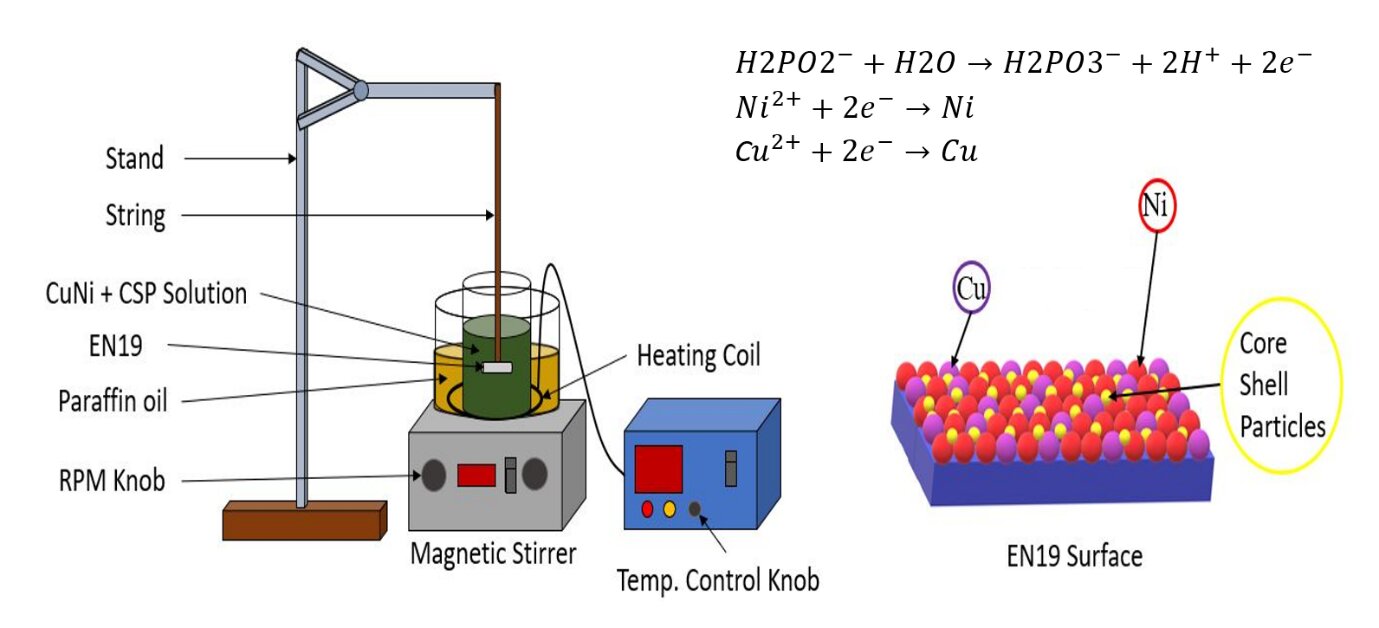
Hard chromium electroplating has been the industrial standard for hardening and protecting steel surfaces for decades, but hexavalent chromium electrolytes are genuinely carcinogenic, and finding a real replacement that matches its tribological performance has been an active research area for years. Electroless deposition is one promising route: it produces dense, uniform coatings regardless of part geometry, with excellent adhesion and simple processing.
This study deposited electroless Cu–Ni composite coatings reinforced with Fe–Ni/SiO₂ core-shell particles onto EN19 (AISI 4140) alloy steel, a material widely used in automotive, aerospace, and defence components that need high strength and toughness but currently have relatively poor surface wear resistance. We varied the reinforcement loading (0.2, 0.3, and 0.4 g per 400 mL plating bath) to find where coating growth, microstructure, and tribological performance actually peak, since Fe–Ni/SiO₂ core-shell particles had never been evaluated in a Cu–Ni matrix before this work.
The unreinforced Cu–Ni coating showed a dense, continuous nodular morphology with well-defined grain boundaries and minimal discontinuity, a stable, homogeneous autocatalytic deposit. Adding 0.2 g of Fe–Ni/SiO₂ refined the surface and introduced uniformly dispersed particulate features with no significant agglomeration, meaning the particles stayed well suspended in the bath at this loading.
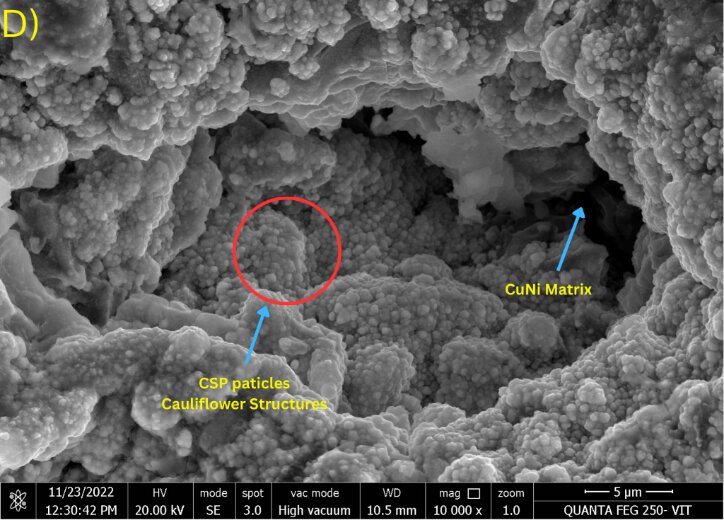
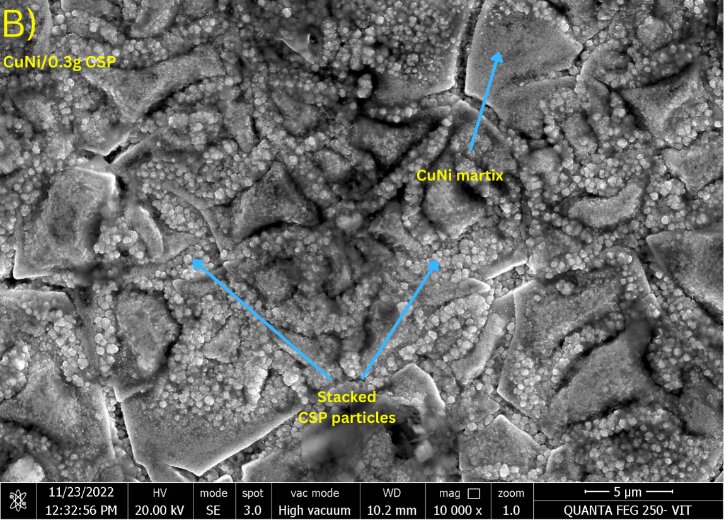
At 0.3 g, the coating developed a highly compact, homogeneous cauliflower-like nodular cluster structure, with the best particle dispersion of any loading tested and no microstructural discontinuities. Push the loading to 0.4 g, though, and the coating started working against itself: pronounced cauliflower-like agglomerates appeared alongside localized cavities and non-uniform deposition, since the particle concentration had exceeded what the bath could effectively disperse.
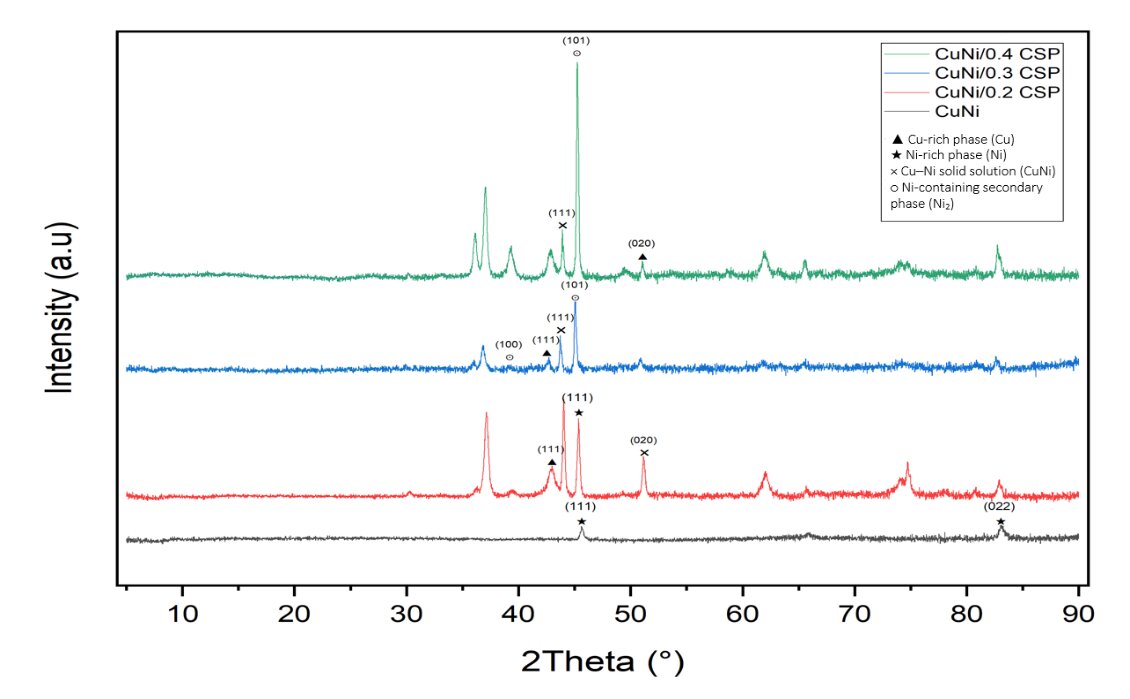
The unreinforced coating showed broad diffraction peaks dominated by the Cu–Ni matrix, typical of a fine-grained, nearly nanocrystalline electroless deposit. Peaks sharpened and intensified progressively as reinforcement loading increased, up to 0.3 g, where the sharpest, most intense peaks appeared, matching the most homogeneous surface morphology seen in SEM. At 0.4 g, minor reflections and structural heterogeneity crept back in, a diffraction signature of the same particle agglomeration visible under the microscope, without any genuinely new crystalline phase forming.
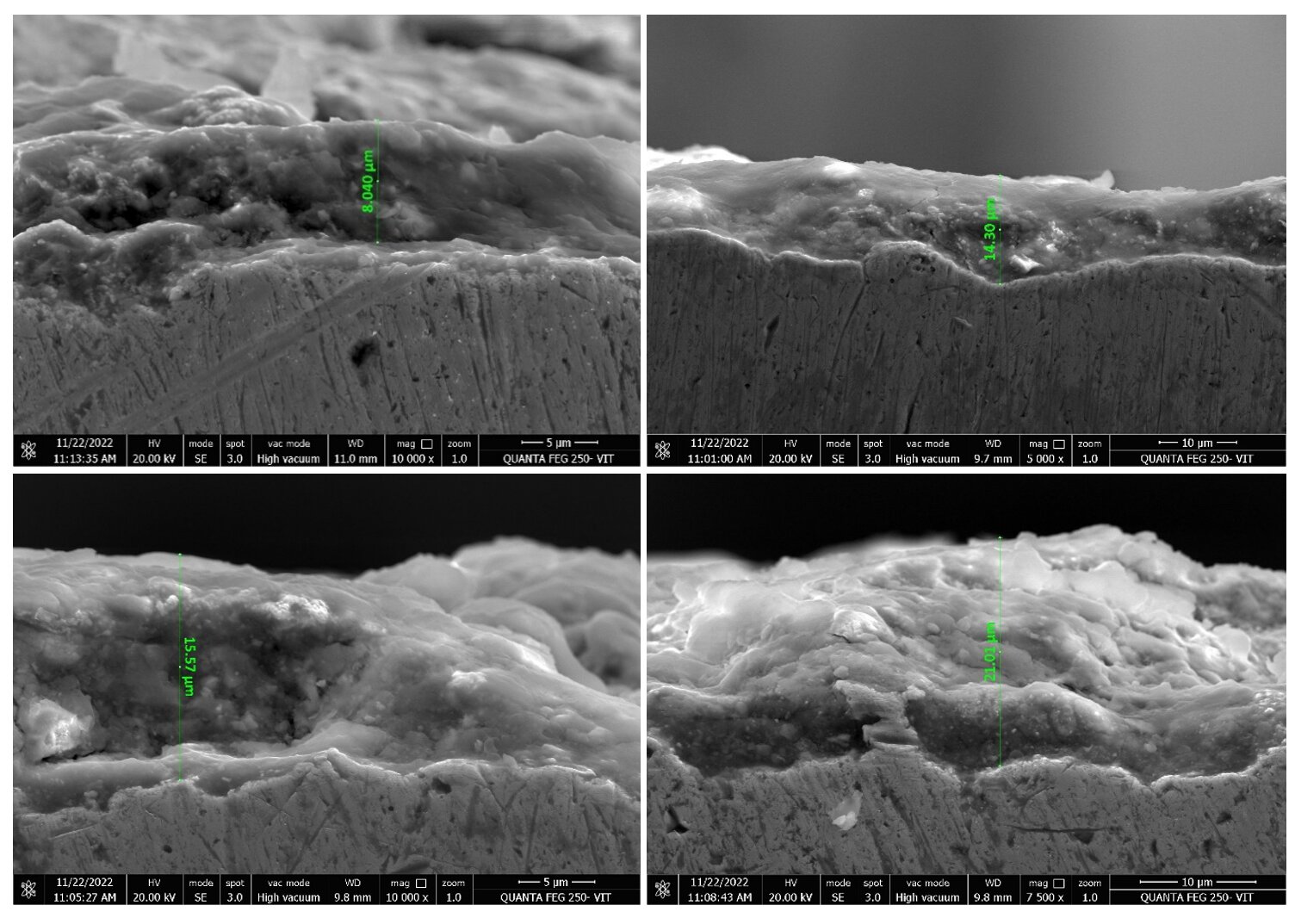
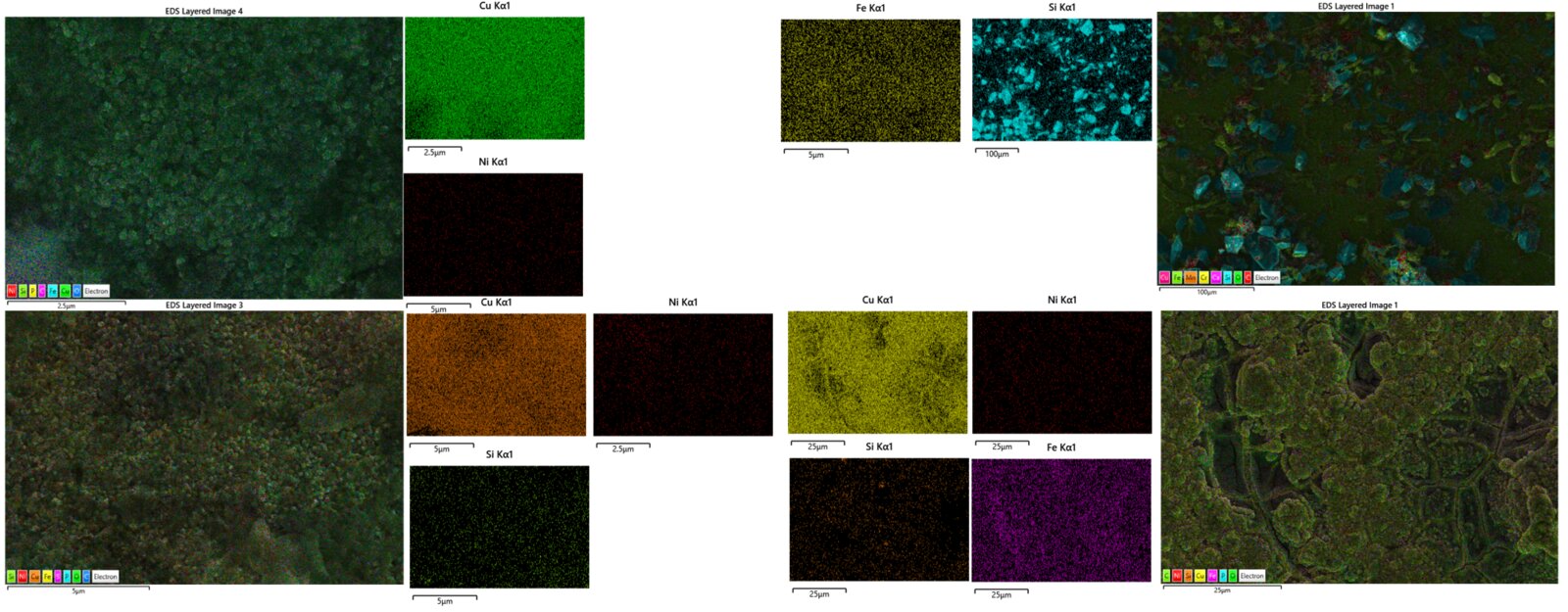
Every coating adhered cleanly to the EN19 substrate with no interfacial cracking or delamination. Coating thickness climbed steadily with reinforcement: 8.04 µm unreinforced, up to 14.30, 14.74, and 21.01 µm at 0.2, 0.3, and 0.4 g respectively, since the suspended core-shell particles themselves promote additional composite growth during deposition. EDS confirmed the mechanism directly: Fe and Si signals grew progressively stronger with loading, and mapping showed Cu and Ni forming a continuous structural matrix while Fe, Si, and O sat dispersed through it as the reinforcing phase. The 0.3 g coating again showed the most uniform elemental distribution of any loading, while 0.4 g showed localized Fe/Si/O-rich clusters, the elemental fingerprint of particle agglomeration.
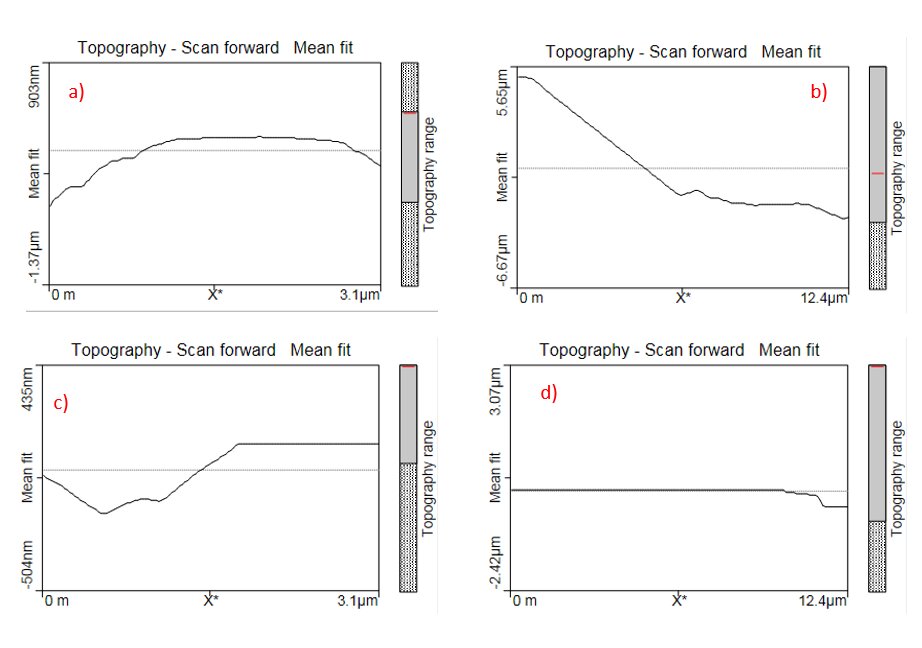
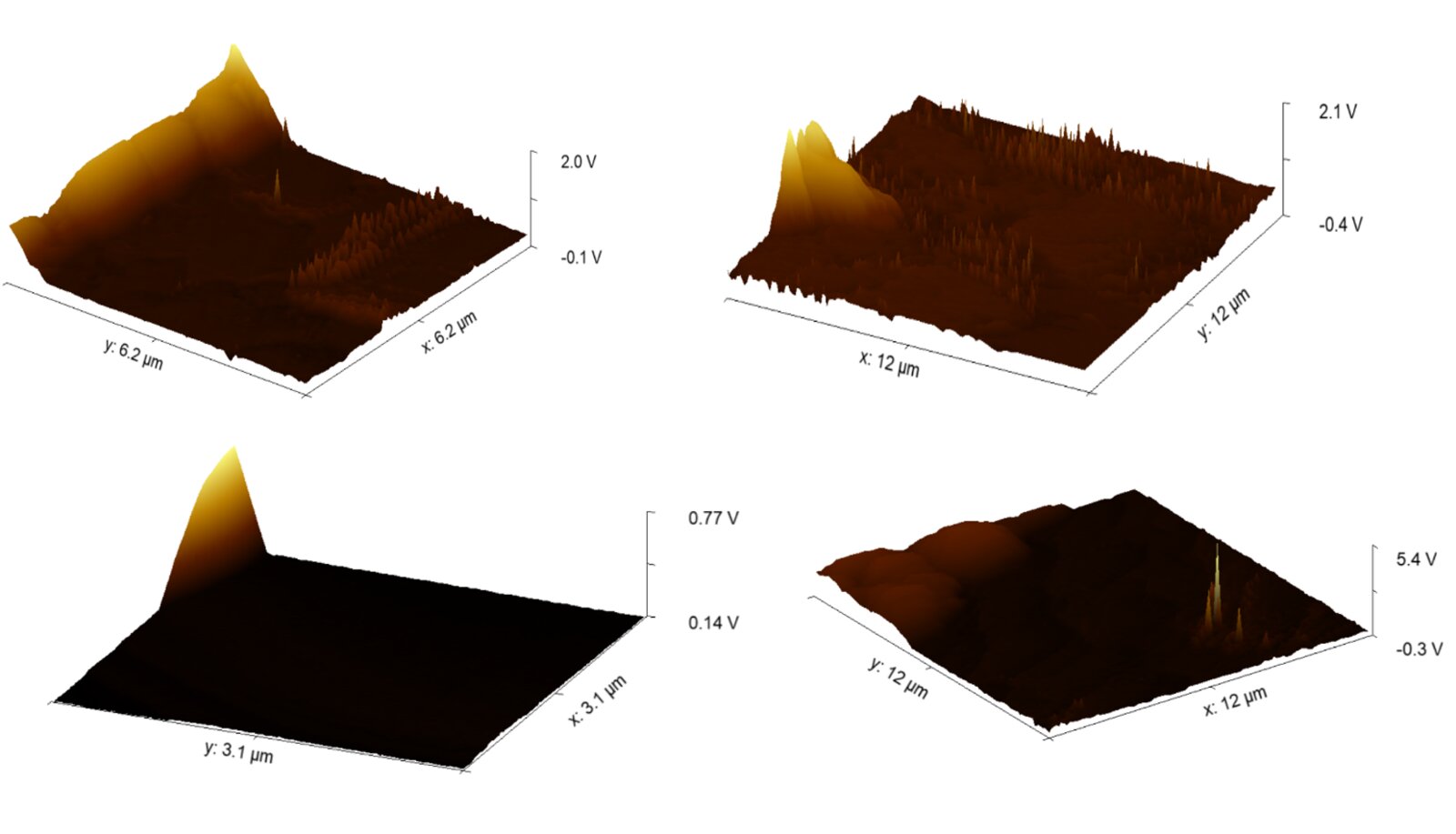
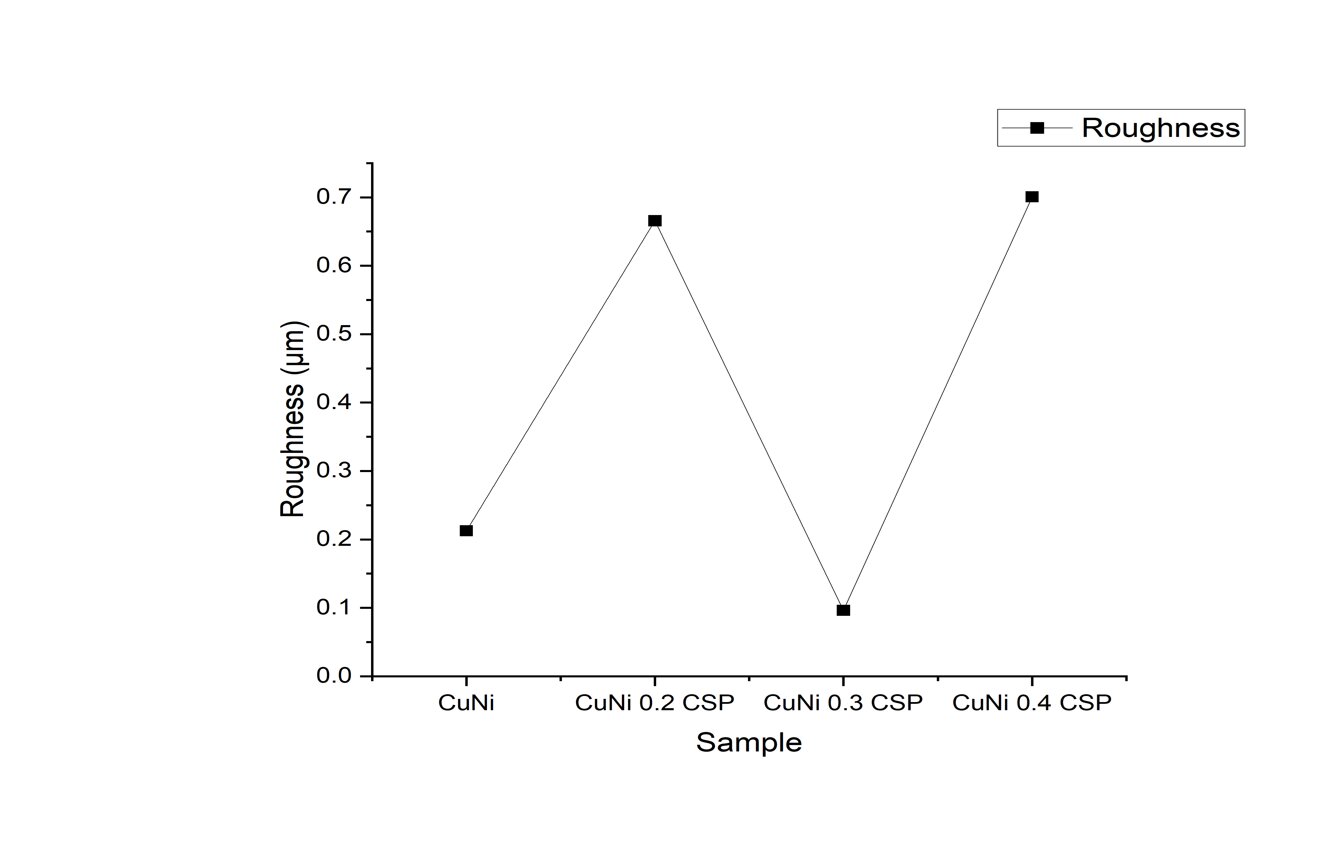
Atomic force microscopy backed up everything SEM had shown. The unreinforced coating had minor, uniform undulations. At 0.2 g, pronounced asperities and localized height fluctuations appeared, a common early-stage effect where suspended particles disturb growth before dispersing more evenly. At 0.3 g, the height profile smoothed out substantially, the lowest roughness of any loading tested, confirming the best particle dispersion and most stable deposition kinetics. At 0.4 g, broader height fluctuations reappeared, tracking the same agglomeration story seen in SEM, XRD, and EDS.
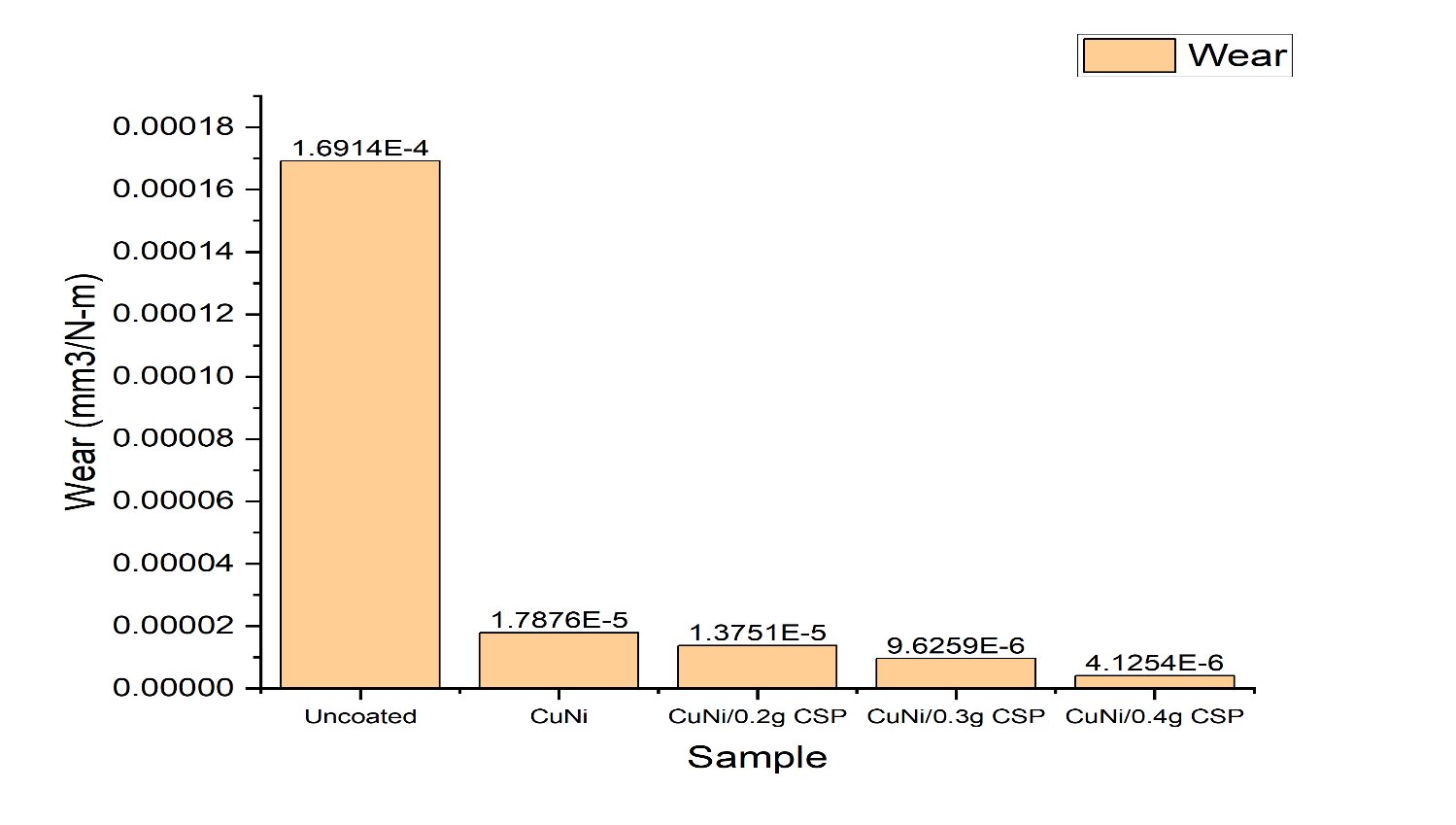
Every coated specimen dramatically outperformed the uncoated EN19 substrate in wear. The unreinforced Cu–Ni coating already cut wear rate to 1.7876 ×10⁻⁵ mm³N⁻¹m⁻¹, and progressive Fe–Ni/SiO₂ loading pushed that further down to 1.3751 ×10⁻⁵, 9.6259 ×10⁻⁶, and 4.1254 ×10⁻⁶ mm³N⁻¹m⁻¹ at 0.2, 0.3, and 0.4 g respectively, the highest loading giving a 77% wear reduction relative to the unreinforced coating and roughly 94% relative to uncoated EN19.
Friction told a slightly different story, with an optimum rather than a monotonic trend. The uncoated substrate had the highest friction coefficient, the unreinforced Cu–Ni coating averaged 0.769, and 0.3 g Fe–Ni/SiO₂ hit the lowest average friction coefficient of the whole study at 0.285, a 63% drop. At 0.4 g, friction crept back up slightly despite the lowest wear rate, because the localized particle agglomeration that helps resist material removal also disrupts otherwise smooth sliding contact. Worn-surface SEM backed this up directly: the unreinforced coating showed deep grooves from dominant abrasive wear, 0.3 g showed the shallowest grooves and least debris of any condition, and 0.4 g showed low wear but slightly rougher sliding.
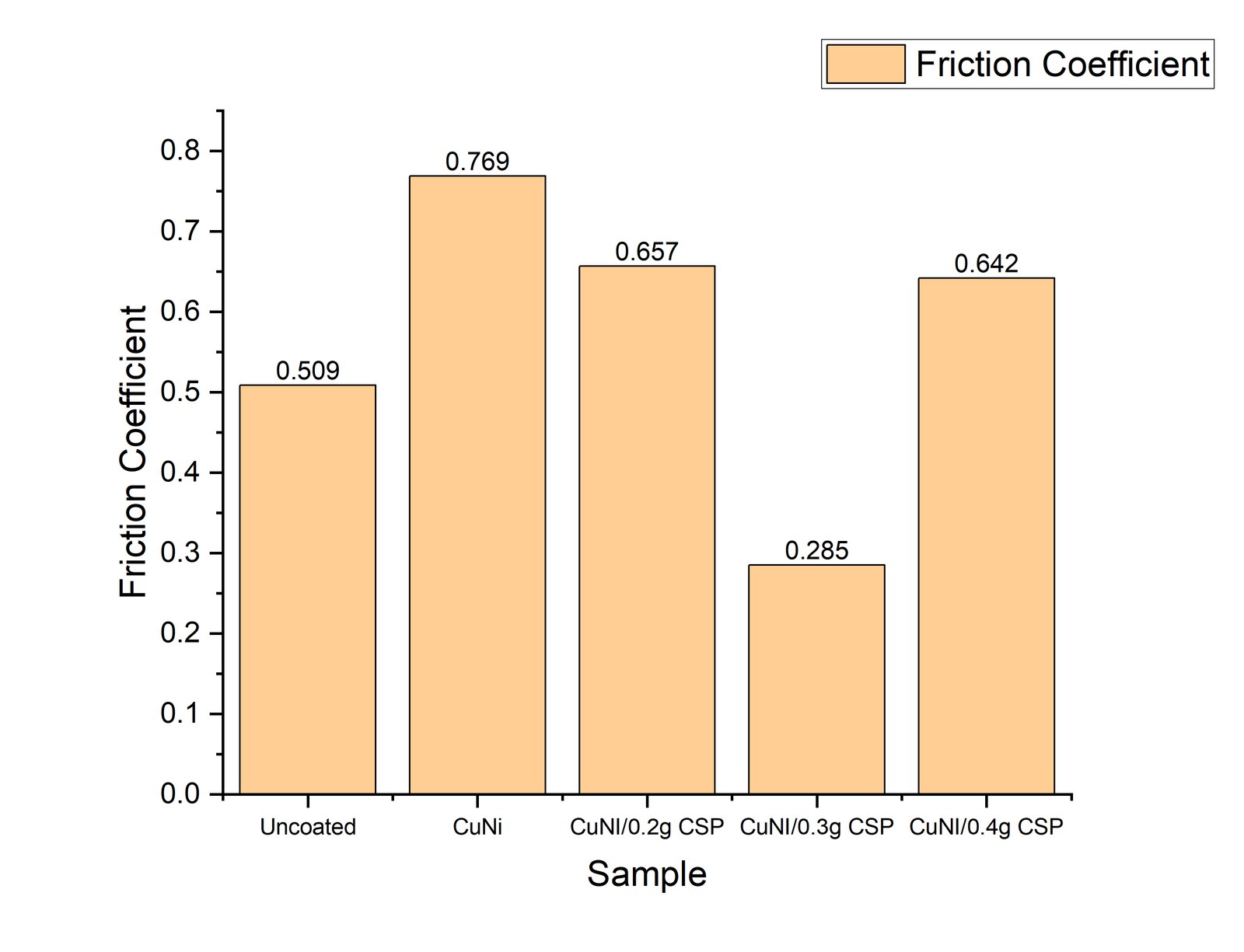
0.3 g Fe–Ni/SiO₂ gave the best overall balance across this study: strong hardness retention, the lowest friction coefficient measured, and wear performance close to the best result, without the structural agglomeration that showed up at the highest loading.